


|
|
|
|
|
#31
 12-01-2009, 02:28 PM
|
||||
|
||||
|
Quote:
__________________
Regards, Ian White 1995 E300 Diesel w124 OM606 2014 E550 w212 M278 biturbo 2001 BMW 740i E38 M62 (past) 1981 300SD w126 OM617 (past) 
|
|
#32
12-01-2009, 10:21 PM
|
|||
|
|||
|
Don't mean to butt in, but thinking about this is like therapy for me.
After reading up on how the Delivery Valves work, or what they do rather, I get the sense that the Collar is effectively a pressure regulator, setting or regulating the post injection/pre injection line pressure to a pressure that is bellow the pop pressure, but high enough to be a stable starting pressure for a consistent time from start of injection to when the injector pintle actually lifts off its seat. My Understanding is the axial distance from the contact area of the Seat, to the bottom of the Collar acts as a consistent displaced volume when the Injection flow has stopped, (it is the flowing fuel during injection, (Pintel off seat), that holds the Delivery Valve open, (Collar out of Valve Bore). As long as the Collar is out of the Bore the plunger can float up and down with out affecting line pressure "via displacement". (This is actually a backwards example, but I think it is easy to picture. Imagine a syringe with a pressure gauge on the needle end and the plunger pulled out. As long as the plunger is not in the syringe bore, you can move the plunger all you want in the air and the pressure in the syringe will not change). Once the bottom of the Delivery Valve Collar enters the Bore, the area from the bottom of the Collar to the injector is now "Isolated" from the Element. (Imagine the plunger was inserted into the syringe. Now the area in the syringe is "Isolated" from the atmosphere, and if the plunger is moved, the pressure in the syringe will change due to the plunger displacing area in the closed volume of the syringe). In the above syringe example, the area in the syringe, and area in the Fuel Injection Line, are both affected by the displaced volume as the result of the Plungers or Collars movement in a Bore. I have looked at different Delivery Valves out of different applications and you can see that the distance from the Plunger Seat to the bottom of the Collar and the Collar width varies depending on the application, I think the variations balance line length, pop pressure, and operating RPM range. I will be willing to wager that if you measured how much increased area is created from the lines swelling that there will be a direct correlation to the "Effectively", (Note the clarification, "Effectively", as the Collar is not sealed to the Bore and allows leakage), displaced volume that the Delivery Valve Plunger displaces once the Collar enters the Bore. I put the Note in there because the Plunger has a spring pushing it back down on to the Seat. Since there is leakage or blow-by past the Collar, it would be possible that the Plunger Return Spring could/should overcome the Element chamber pressure after the end of injection, and any fuel that would pass by the Collar would replace that amount of displaced area vacated by the descending Plunger. Thus the "Effective" displacement volume would be the area of from the bottom of the Collar to the Seat, minus any blow by, and I imagine that “Effective” displacement varies with RPM. When the Collar Diameter is reduced or is Grooved, the amount of blow by is increased, reducing the "Effective" displacement of the Plunger, resulting in a higher post injection/pre-injection line pressure. This would in turn result in a decrease in the number of crankshaft degrees needed after the start of injection, to reach the Pop pressure, due to line swell, (Effectively advancing the injection timing). I can see why the Idle would be unstable with Modified Delivery Valve Collars, as the "Injection Curve Dampening Affect", (for lack of a better name), that is created by the lines swelling, much like the notorious "Cigar Hose" on the return line is supposed to help reduce the pulsing in the primary fuel system, is effectively reduced. The calibrated post-injection/pre-injection line pressure helps insure that a consistent absorber is present to help prevent from surging the Injector Pintel causing it to initially lift too far off its seat, resulting in a Injection that is more of a stream instead of a fog. I’m sorry, It looks like we are out of time, ( I am late for an engagement). As always I am open to apposing viewpoints. Thanks to all for the quality time.
|
|
#33
12-01-2009, 11:42 PM
|
||||
|
||||
|
Looks good, anyone else ready to counter this?

__________________
Regards, Ian White 1995 E300 Diesel w124 OM606 2014 E550 w212 M278 biturbo 2001 BMW 740i E38 M62 (past) 1981 300SD w126 OM617 (past)
|
|
#34
12-02-2009, 12:14 AM
|
||||
|
||||
|
Very nice write-up! And i would agree and matches what ive been thinking pretty well too. Not much doubt that the timing is advanced, the throttle response is quite snappy on the cut DV's aswell. Pretty sure they could be made to run quite well with alot of tuning and adjustments. For the average guy, it would likly mean quite alot of time and experimentation to get it dialed in. I would like to try but dont have that time to do alot of tinkering as of now. I have acsess to all the factory MBZ diesel injection tools but this is getting into more serious pump mods where specialty diesel injection equipment would simplify life/tuning of these.
If i had the cash, id send a whole pump to Columbus Diesel Service and let them work some magic on it if they can. If those guys can machine a whole new custom billet Sigma pump from scratch, i'd bet they can wake one of these MW pumps up. Worse comes to it, find an M-pump. Or investigate adapting a P7100 and remove/plug one pump element. That should give more fuel than a 617 could handle
__________________
87' 300D, Currently undergoing an OM606 swap/build!  SUPERTURBO!!! SUPERTURBO!!!03' 2500HD Dmax + goodies! 82' 300SD, parting out! 93' 300TE 4matic, parting out! 83' 240D Project Cheap Drive 89' 300E, parting out! 74' Datsun 510 wagon  88' RX7 10thAE, 13B track car build soon Skippy~ As for perception: Drive what you like and can afford. Those who don't like it can supply vacuum to one of your components. LOL  If you need parts, I have some!
|
|
#35
12-02-2009, 12:26 AM
|
||||
|
||||
|
Too bad these 617's are IDI...
__________________
Regards, Ian White 1995 E300 Diesel w124 OM606 2014 E550 w212 M278 biturbo 2001 BMW 740i E38 M62 (past) 1981 300SD w126 OM617 (past)
|
|
#36
12-02-2009, 12:59 AM
|
||||
|
||||
|
Quote:
 .... IDI wouldnt stop me drop the compression some/forged pistons, modded pre-chambers?, modded IP, polish&peen the rods, weight match and balance the rotating assembly, Schnider can regrind cams, port the head, valves/seats, fab intake and header, and some compound twins prolly 60mm-ish on the top charger and 40mm area on the high pressure turbo. Oh and cant forget a healthy intercooler maybe M/W injection? .... IDI wouldnt stop me drop the compression some/forged pistons, modded pre-chambers?, modded IP, polish&peen the rods, weight match and balance the rotating assembly, Schnider can regrind cams, port the head, valves/seats, fab intake and header, and some compound twins prolly 60mm-ish on the top charger and 40mm area on the high pressure turbo. Oh and cant forget a healthy intercooler maybe M/W injection?I read somwhere, back in the 80's, Hypermax (Ford diesel tuner) went all-out on the IDI 7.3L Navistar/IH/Ford diesel. They were claming over 1200HP out of those IDI's. Only weak point was the blocks were coming apart. IDI's can make power too! If i was extra ambitious, have some custom slugs cut with a Direct Injection bowl design, and machine some adaptors that replace the prechambers to fit DI injectors and a P7100 feeding them. Feasable, yes, and quite insane, but no reason it cant work. Its just an engine. If guys can put John Deere injectors in 12v Cummins, or convert a 7.3 Stroke from HUEI injection to mechanical P-pumped, or squeeze 900+HP from a 4bt. A fella on the Dmax forum has a 3.9L Isuzu thats all cranked up, compound twins, Schied 400cc pump, etc. How many badass 3.9 Isuzu's have we heard of ? .....No reason the 617 cant share the fun.
__________________
87' 300D, Currently undergoing an OM606 swap/build! SUPERTURBO!!!03' 2500HD Dmax + goodies! 82' 300SD, parting out! 93' 300TE 4matic, parting out! 83' 240D Project Cheap Drive 89' 300E, parting out! 74' Datsun 510 wagon 88' RX7 10thAE, 13B track car build soon Skippy~ As for perception: Drive what you like and can afford. Those who don't like it can supply vacuum to one of your components. LOL If you need parts, I have some!
|
|
#37
12-02-2009, 01:09 AM
|
||||
|
||||
|
Quote:
__________________
Regards, Ian White 1995 E300 Diesel w124 OM606 2014 E550 w212 M278 biturbo 2001 BMW 740i E38 M62 (past) 1981 300SD w126 OM617 (past)
|
|
#38
12-02-2009, 01:25 AM
|
||||
|
||||
|
Quote:
I hear ya! I dunno, just the way I am, Its hard for me to leave well enough alone! Not always about power, sometimes just like to add my custom touches. My SD is my daily driver, so it dosnt need to be over the top radical but a bit more power would be nice! I wouldnt mind having a W123 i could get wild with though! My buddy has his a W123 in my yard awating me. Its a 240D with a slushbox. Once its alive, it has a turbo and intercooler awating it. I have my doubts the auto trans will be satisfactory, might takeon trying to swap a manual in there, but no lame 4spd, rather adapt a T-5 in there somehow. He wants it lowered and tucked with the fenders flared, rollin on some wide, period correct BBS's. Should be fun
__________________
87' 300D, Currently undergoing an OM606 swap/build! SUPERTURBO!!!03' 2500HD Dmax + goodies! 82' 300SD, parting out! 93' 300TE 4matic, parting out! 83' 240D Project Cheap Drive 89' 300E, parting out! 74' Datsun 510 wagon 88' RX7 10thAE, 13B track car build soon Skippy~ As for perception: Drive what you like and can afford. Those who don't like it can supply vacuum to one of your components. LOL If you need parts, I have some!
|
|
#39
12-02-2009, 01:50 AM
|
|||||||||
|
|||||||||
|
Quote:
Quote:
Quote:
Quote:
Quote:
Quote:
Quote:
Although, I completely disagree with "lines swelling". This is misleading. The lines are conduits only. The pressure wave traverses them and their 'size' might appear to change from point to point... but they do not swell as an entire unit... this would have a terrible effect on timing. Steel does not flex at varying rates to compensate for the range of engine speeds that would be encountered. Quote:
The retaining spring for the DV cannot repsond quick enough at idle, hence the collar. - It capitalizes on pressure diffential and the return flow of fuel into the element as the plunger recedes. Quote:
By 'events', I mean all the variables involved with the act of injection. Such as: chatter between the injector and the respective pressure in the lines.
|
|
#40
12-02-2009, 03:51 AM
|
||||
|
||||
|
Quote:
Quote:
Also, when can one install 6.5 mm elements and plungers? See thread': http://www.superturbodiesel.com/std/whats-up-with-cut-delivery-valves-t-890.html and http://www.superturbodiesel.com/std/inte...http://www.superturbodiesel.com/std/interest-in-mw65-holly-elements- Thanks!
__________________
Regards, Ian White 1995 E300 Diesel w124 OM606 2014 E550 w212 M278 biturbo 2001 BMW 740i E38 M62 (past) 1981 300SD w126 OM617 (past)
|
|
#41
12-02-2009, 04:31 AM
|
|||
|
|||
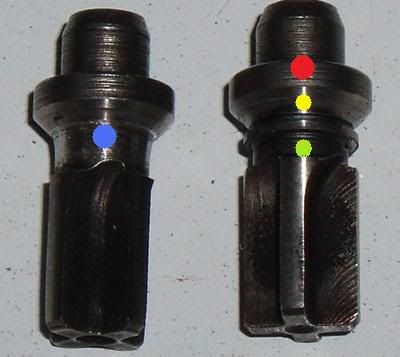 yellow = conical surface = the DV valve seat and sealing surface. Without the collar, you depend solely on the return spring to end injection events. This is highly inaccurate and uncontrolled. Like jumping off a roof onto a trampoline instead of using fall protection and a harness. If you are a machinist, perhaps you could find some high precision springs to replace the 'good enough' Bosch return springs?... I can't really guarantee anything positive. Personally, I think the high EGTs are a result excess fuel being dumped into the cylinder at an unbalanced rate. Dribbling injectors, elongated events and lots of wasted fuel since the metering of the fuel at progressive rates is not there.
|
|
#42
12-02-2009, 05:29 AM
|
||||
|
||||
|
I wonder if the larger OM606 injectors with a lower pop pressure set would help. I could try to find small springs, the only problem is that we are getting into unmapped territory. Again, thanks for the explanation on the sealing surface...I was wrong...again
__________________
Regards, Ian White 1995 E300 Diesel w124 OM606 2014 E550 w212 M278 biturbo 2001 BMW 740i E38 M62 (past) 1981 300SD w126 OM617 (past)
|
|
#43
12-03-2009, 01:01 AM
|
|||
|
|||
|
Quote:
However I see an area that opened up for discussion as the result of your evaluation of my pervious thoughts. I have seen tremendous arguments, (that turned persona, about the concepts that will follow. In an effort to guard against such a result, I will present some debated operational theories from both sides. Devils Advocate included if you like. Is it safe to say; 1) That it is agreed upon that the DV, in some way shape or form, manages, or has an effect on, the Post- Injection/Pre-Injection line pressure. 2) That the pressure in the line at the start of injection, (when the barrel fill port is covered by the element), has an effect on the length of time from the start of injection, to when the Injector Pintel actually lifts off its seat. 3) That by modifying the DV Collar, the Post-Injection/Pre-injection line pressure is increased. 4) That by modifying the DV Collar, the length of time from the Start of Injection to when the Injector Pintle actually lifts off its seat is reduced. 5) That increasing the pop pressure increases the time from the Start of Injection to when the Injector Pintle lifts off its seat. The concept that the DV Collars job is to assist, (or increase the speed of), the closing of the DV is interesting. I agree that the Collar could assist in the closing of the DV if there was a sufficient force differential, where the pressure was higher above the Collar than beneath it. However, and this is where it gets interesting, what is causing or storing the residual pressure that forces the fuel back to the IP (which, as reasonably suggested, pushes against the DV Collar to assist in closing of the DV), coming from? A) Some will argue that the fuel itself compresses during the injection process, and it is the fuel trying to expand back to its normal volume that maintains some pressure. This expansion causes fuel flow ultimately back to the IP fuel cavity. As the fuel flows, the DV moves with, and or, as the result of the flowing fuel. B) Some will argue that the lines are expanding, (or any other term for the increasing of inner volume due to a differential pressure, (internal to external)), and it is the lines returning back to their normal size that causes a source of pressure after the end of injection. As the fuel flows, the DV moves with, and or, as the result of the flowing fuel. C) There is also an argument that the only energy in the lines after the End Of Injection is Sonic, as since, if the fuel is not compressing and the lines are not expanding, there is not any stored energy that needs to be released, and that the pressure wave is created by the Injector Pintle hitting its seat. Regardless of theories, if it is agreed upon that after the End of Injection, there is a sufficient quantity, (volume), of fuel stored, (under pressure), to effectively push, (cause to move a measurable distance), the DV closed, in an effort to equalize the Line pressure to that of the Element Barrel, then there has to be a source of the stored energy, (pressure), somewhere in the Injection System between the DV and the Injector. My understanding is that Energy is neither created nor destroyed, it only changes state, and it can be stored. If “A” were true, it would be easy to imagine how the energy is being stored, just like an air pressure talk stores pressurized air. The tank, (or Injection Lines) in theory could remain volumetrically constant but since air, (or for the sake of this argument, fuel) is compressible, it is possible to store a grater volume of air, (fuel), than the tank’s, (Line’s), actual volumetric capacity. If “A” is not true then that is not the source of the stored energy. As for “B” My only knowledge stems from a high speed film I saw, a long time ago, of an Injection line on a Cummins that showed the line’s length changing “a measurable degree” the commentator said, during the pressure ramp up. They were having problems with lines breaking on the early higher pressure systems that were being developed. It did not say anything about the diameter of the lines increasing, only that the length was changing. The best example I can think of, is a garden hose. When the water is turned on, you can feel it expand and become firmer as the structural cords are stretched, (the hose is internally expanding from the internal pressure trying to equalize with the atmospheric pressure). This pressure is stored in the hose after the valve is turned off. This is evident by when you pull the trigger on the nozzle after the source valve is turned off, you will get a pulse of water as the inner and outer pressures equalize. If “B” is true it is again easy to see where the energy is stored in the Injection System. I could see that if the Pop pressure is theoretically constant that the Injection line would grow a reasonably consistent amount and that the growth could be calibrated into the DV’s operation. If “B” is not true, then that is not a source of the stored energy. If “A” and “B” are out of the equation, then the only other energy source that would, at this point in my understanding, be plausible is Sonic? or Inertial?, caused by the sudden stopping of the fuel and or Injector Pintle against its seat. Continued on next post due to length.
|
|
#44
12-03-2009, 01:02 AM
|
|||
|
|||
|
Continued from above,
Sonic energy would not be stored energy rather energy converted when the Injector Pintle is forced onto its seat by the powerful spring in the Injector assembly, and or from the abrupt stopping of fuel flow when the Pintle shuts. The fuel inertial percussion wave would be dependent on the speed and density of the fuel at the time it stopped flowing. Any thoughts as to how fast the fuel is flowing through the Injector lines at various rack settings? A Sonic wave would transfer energy through the Fuel and Line walls at the speed of sound at the given medium density, (Darn Fast). Because there are two different mediums, fuel and the steal line, there would be two waves traveling at different speeds. A Sonic wave would echo back and forth until it decayed to the point that it can not sustain a return wave, or until/unless it is absorbed, (not allowed to echo back causing a secondary injection pulse). In order for the DV to absorb the Sonic wave, I would imagine it would have to be able to initially move at the speed of the wave and then gradually slow down, like catching an egg that was tossed to you. If you hold you hand steady and catch the egg, the energy of the moving egg will try to keep it moving and the energy will be converted rapidly, (impact), and the egg will brake. But if you can match the eggs speed at the moment that the egg contacts your hand and then slowly come to a halt, the energy is converted gradually and the egg will survive intact. If the DV Collars job is to capitalize on, or utilize, the Sonic pressure wave energy in an effort to match the speed of the wave, then removing the DV Collar would have a profound affect on the DVs ability to dampen any Sonic pressure waves that could be present. However in order for the DV to absorb any type of frequency, it would need to be able to move equal to, or faster than, the speed of the frequency, (FAST). One problem with this scenario I see is, if there is not a displaceable pressure source between the DV and the Injector that would cause fuel to be excreted or expelled from the fuel line at the End of Injection, (as would be the case in “A” or “B”), allowing the DV to move with the fuel, instead of having to displace fuel in the process of movement, as no two things can occupy the same space at the same time. If “A” and “B” are not an option, then in order for DV to move, (catch the egg), fuel would have to quickly flow past the DV Collar from the Element side to the Injector side to fill the area that was previously displaced by the DV, and I would imagine that the viscosity of the fuel having to pass through the close gap between the DV Collar and the DV Body Bore, would act as quite a source of resistance. Maybe that is key to how it works? Thoughts?
|
|
#45
12-03-2009, 01:27 AM
|
||||||
|
||||||
|
First, let me say that I truly appreciate these types of discussions and I hope that none of my responses come across as 'devil's advocate' or antagonistic.. I promise not to make it personal.
Before I write up a formal response, I will answer the questions and summarize some thoughts. Quote:
Quote:
"the pressure in the line at the beginning of delivery (when the fill port is covered by the plunger), has an effect on the length of time from the beginning of delivery to the start of injection (when the pintle lifts off the seat)." ..and I agree, it does. Quote:
Quote:
Quote:
Quote:
Last edited by jt20; 12-03-2009 at 01:44 AM.
|
 |
| Bookmarks |
|
|


 Linear Mode


